Guide to Dataswyft Network
-
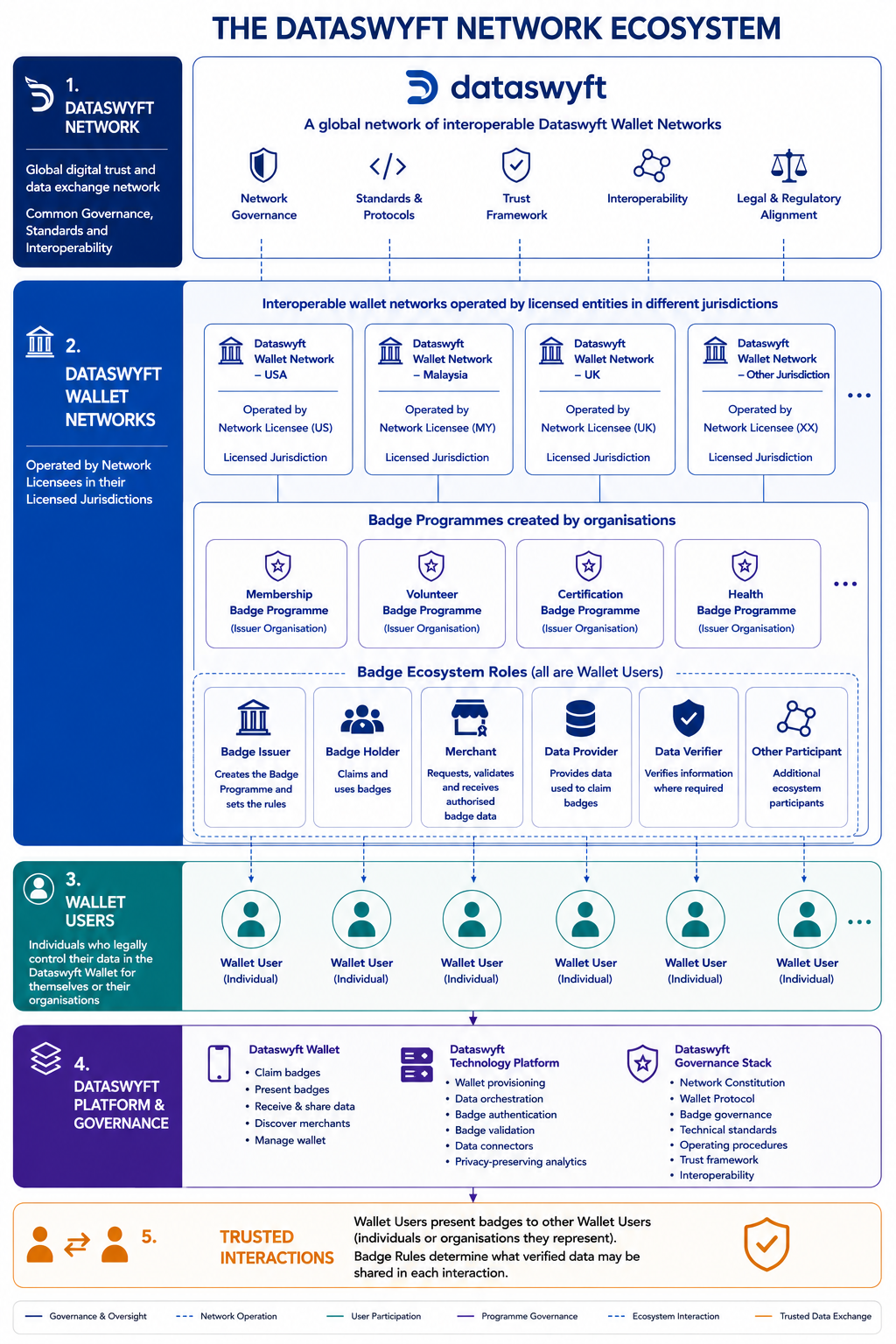
The Dataswyft Network is a global digital trust and data exchange network comprising interoperable Dataswyft Wallet Networks operating under a common governance and trust framework.
Each Dataswyft Wallet Network is operated by a licensed Network Licensee and provides the jurisdictional infrastructure through which individuals establish Wallet Accounts, organisations establish Badge Programmes, and trusted digital interactions take place. Together, these Wallet Networks form a single interoperable Dataswyft Network.
At the centre of every interaction is the Dataswyft Wallet, where individuals legally control data relating to themselves or to organisations they are authorised to represent. Rather than exchanging data directly between organisations, trusted interactions take place between Wallet Users, with programmable badges governing what verified information may be shared and with whom.
By combining programmable governance with existing legal frameworks, the Dataswyft Network enables secure, interoperable and scalable digital ecosystems while keeping individuals in legal control of their data.
-
Badges are programmable digital governance objects that combine verified information with the rules governing its use and sharing.
Rather than issuing credentials directly, organisations establish Badge Programmes that define how badges are claimed, presented, validated and used. Individuals claim badges into their Dataswyft Wallets and use them whenever they need to prove something or exchange trusted information.
Each badge defines:
who may claim it;
what data is required;
how that data is verified;
who may receive it;
what verified data may be shared; and
any other rules governing its use.
Badges may represent:
Identity
Membership
Participation
Qualifications
Certifications
Loyalty
Entitlements
Permissions
Compliance
Forms and declarations
-
A Badge Programme is the governance framework established by an organisation for one or more badges.
Each Badge Programme contains one or more Badge Templates, which specify the rules under which individuals may claim badges.
To claim a badge, a Wallet User acquires the required data into their Dataswyft Wallet from authorised Data Providers or approved services.
Once the Badge Rules have been satisfied, the badge is authenticated and claimed into the Wallet.
Whenever the badge is presented, the Wallet User decides whether to present it and to whom, while the Badge Rules determine what verified data may be shared for that interaction.
-
Every Badge Programme creates its own Badge Ecosystem.
A Badge Ecosystem typically comprises:
Badge Issuer — establishes the Badge Programme and Badge Rules.
Wallet Users — claim and present badges.
Merchants — request, validate and receive authorised badge data.
Data Providers — supply data used to authenticate badges.
Data Verifiers — verify information where required.
Participants may perform multiple roles within the same ecosystem.
Example
A charity establishes a Community Badge Programme.
Its Badge Ecosystem may include:
volunteers claiming Volunteer Badges;
the charity providing volunteer records from its CRM;
partner charities recognising the badge;
merchants offering volunteer benefits;
Activity partners validating volunteer badge, generating interaction record of volunteer activity and impact shared with badge issuers, badge holders and partners without identity leakage.
The charity governs the Badge Programme, while the Dataswyft Network enables trusted interactions across the ecosystem.
-
The Dataswyft Network provides the common governance and technology infrastructure that enables independent Badge Ecosystems to interoperate across multiple Dataswyft Wallet Networks.
Dataswyft Wallet
The Dataswyft Wallet enables Wallet Users to:
claim badges;
present badges;
receive authorised data;
share authorised data;
discover participating merchants;
manage their Wallet.
Dataswyft Technology Platform
The platform provides:
Wallet provisioning
Data orchestration
Badge authentication
Badge validation
Data connectors
Privacy-preserving analytics
Dataswyft Governance Stack
The Governance Stack provides:
the Network Constitution;
the Wallet Protocol, Legal Code and Trust Framework
Badge Programme governance;
Technical Standards;
Network Operating Procedures;
interoperability across Wallet Networks.
-
Traditional digital platforms rely on direct integrations and bilateral agreements between organisations.
The Dataswyft Network replaces this with programmable governance. Organisations establish Badge Programmes that define the rules for trusted interactions, while Wallet Users control whether to participate and with whom they interact. Badge Rules determine what verified data may be shared in each interaction.
This enables independent organisations to participate in trusted digital ecosystems without bespoke integrations or bilateral contracts, creating secure, interoperable and scalable networks built on common governance rather than point-to-point connections.
In addition, every interaction between wallet users is a legal attestation of that interaction, rather than a platform attestation. This enables accountability and liability to be assigned appropriately.
Watch a video on a use case